


INTEGRATIONS
CATIA Magic and Codebeamer Integration
SysML models and ALM requirements connected through governed, bidirectional integration — so your architecture and your ALM platform evolve together instead of apart.
BOOK FREE DEMOCATIA Magic and Codebeamer are both strong tools. The problem is what happens between them.
CATIA Magic and Codebeamer integration is where most engineering environments start to break down. Teams use CATIA Magic to build SysML architecture, while Codebeamer manages requirements, tests and compliance. In many organisations, these environments remain disconnected, with relationships maintained manually through exports and spreadsheets.
As complexity grows, this approach fails — traceability degrades and inconsistencies surface late. AroTrace connects CATIA Magic and Codebeamer through governed, bidirectional integration, using APIs to turn disconnected tools into a single, traceable engineering system.
Why connecting these tools is harder than it looks

INTEGRATION INTERFACES EXIST — BUT DON’T CREATE TRACEABILITY ON THEIR OWN
Both CATIA Magic and Codebeamer expose APIs that enable technical integration. However, connecting endpoints is not the same as establishing traceability. Without a defined data model, mapping logic and governance rules, the integration stays structurally connected but functionally incomplete.
SYSML STEREOTYPES DON’T MAP TO CODEBEAMER FIELDS BY DEFAULT
A SysML requirement in CATIA Magic carries a different set of attributes than a requirement tracker item in Codebeamer. Block properties, dependency relationships and verification elements have no direct equivalent on the ALM side. Without a configured mapping layer, the integration connects systems technically but leaves them semantically empty.
MAGIC COLLABORATION STUDIO IS A PREREQUISITE MOST TEAMS OVERLOOK
Teams typically expose the integration layer through Magic Collaboration Studio, not the desktop modeling environment itself. In practice, teams running standalone CATIA Magic installations without MCS lack a stable integration endpoint — making integration with external ALM systems significantly more difficult.
LINK MAINTENANCE IS INVISIBLE WITHOUT ACTIVE GOVERNANCE
Once teams establish relationships between tools, they can go stale. A model element is renamed or restructured in CATIA Magic; the corresponding Codebeamer item still references outdated information. Nothing breaks visibly — the relationship simply stops reflecting reality. Without active detection, inconsistencies accumulate silently until an audit or review exposes them.
What the integration changes for your engineering team
Scenario — late-stage requirement revision
A REQUIREMENT CHANGES IN CODEBEAMER TWO WEEKS BEFORE A SYSTEM REVIEW
Without AroTrace: the systems engineer updates the requirement, flags it in the tracker and sends an email. Whether the CATIA Magic model reflects the change depends on whether the right person sees it in time. With AroTrace, the system reflects the update across the integration immediately — connected SysML elements are flagged for review, and the change becomes visible in the trace graph before the next model update. The review starts from a current baseline, not a reconstructed one.
Scenario — architecture refactoring mid-programme
THE ARCHITECTURE TEAM RESTRUCTURES A SUBSYSTEM INTERFACE IN CATIA MAGIC
Interface changes in SysML have downstream consequences that aren’t always obvious: test cases written against the old interface specification, requirements that reference specific signal flows, risk items tied to particular block behaviours. Without a link to Codebeamer, these consequences surface in testing. With AroTrace, the interface change triggers a cross-boundary review flag — the ALM team sees which Codebeamer items are affected by the structural modification before any new test runs begin.
Scenario — functional safety audit preparation
THE PROGRAMME NEEDS TO PRODUCE A TRACEABILITY MATRIX FROM SYSTEM REQUIREMENTS TO VERIFICATION
Under ISO 26262 or DO-178C, demonstrating coverage means showing that every requirement is allocated to an architectural element and covered by a verification case — with timestamped evidence per release baseline. When CATIA Magic and Codebeamer are disconnected, this matrix is assembled manually from exports, usually in the week before the audit. AroTrace generates the evidence directly from the live trace graph, per baseline, with full link history. The matrix reflects what is actually true in the integration — not what was true when someone last ran the export.
One integration layer across the MBSE–ALM boundary
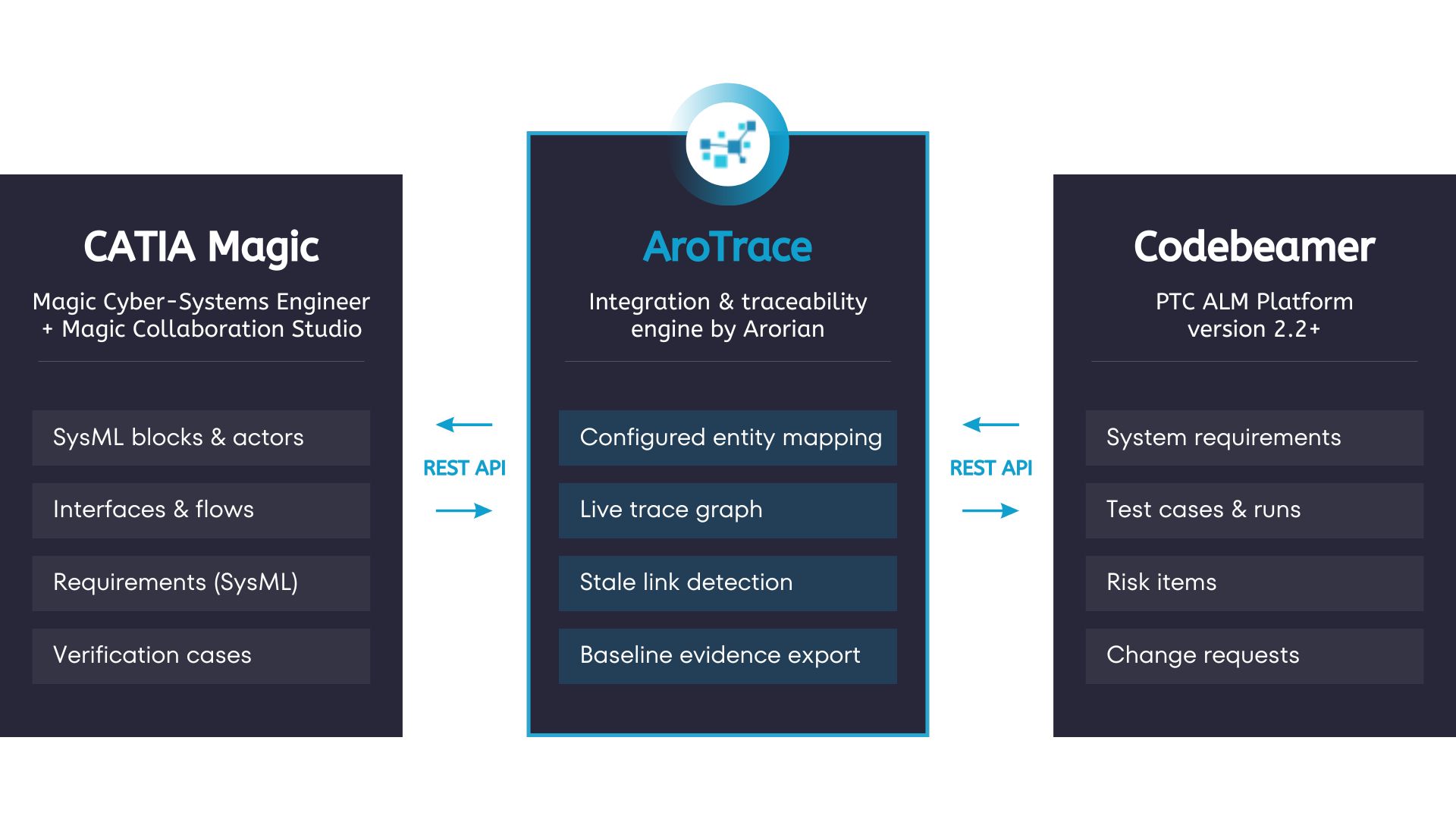
Key capabilities of CATIA Magic and Codebeamer integration
Configured mapping between SysML models and Codebeamer data structures
AroTrace is configured — not installed out of the box — to match your CATIA Magic data model to your Codebeamer tracker structure. SysML elements, relationships and attributes are mapped to specific tracker items and fields, reflecting how your organisation actually works.
Bidirectional integration via APIs across both systems
AroTrace connects CATIA Magic and Codebeamer through their available APIs, enabling persistent, bidirectional data exchange and traceability. Changes on either side are reflected without manual synchronization or re-export.
Stale and orphaned link detection
When a CATIA Magic element is renamed, restructured or removed, related data in Codebeamer may no longer reflect reality. AroTrace detects these inconsistencies automatically and surfaces them for review.
Cross-tool trace graph from requirement to verification
AroTrace maintains a connected graph from Codebeamer requirements through SysML allocation in CATIA Magic to verification elements and test execution. The full chain is queryable and exportable across systems.
Baseline-aware compliance evidence generation
AroTrace generates traceability evidence tied to specific Codebeamer baselines and CATIA Magic model versions — capturing which requirements were linked to which model elements at a given point in time, with full link history. The output is structured for compliance with ISO 26262, DO-178C, and IEC 61508.
Non-disruptive to existing tool configuration
AroTrace operates through the APIs of both systems. It does not modify CATIA Magic model structure, Magic Collaboration Studio configuration or Codebeamer tracker setup. The integration adds a governed traceability layer on top of existing environments.
Ready to connect CATIA Magic and Codebeamer?
Talk to our integration team to review your current CATIA Magic and Codebeamer setup — and see what a configured AroTrace integration looks like for your specific tool environment and traceability requirements.
Book a free traceability review